Homeowners' pick for appliance repair across California
Microwave Repair — Book a Visit Today
We fix microwaves across California as an independent shop, and most failures fall into a handful of patterns. When the plate spins but nothing gets hot, the magnetron is usually done. A stuck door switch makes the whole unit act dead. High-voltage diodes and capacitors fail with a hum or a pop, turntable motors seize, and touchpads go blind in spots from grease and heat working in under the membrane. Over-the-range units have a habit of killing their own control boards, because stove heat rises and bakes them for years. A visit starts with your description of what happened. Then we test the door interlocks, discharge the capacitor, and check the high-voltage side before anything else gets touched. Call us and tell us what you saw or smelled.
Call (888) 352-5066- Real people on the phone
- 7 days a week
- Quote in writing before any work
Taking calls until 5:00 PM PT
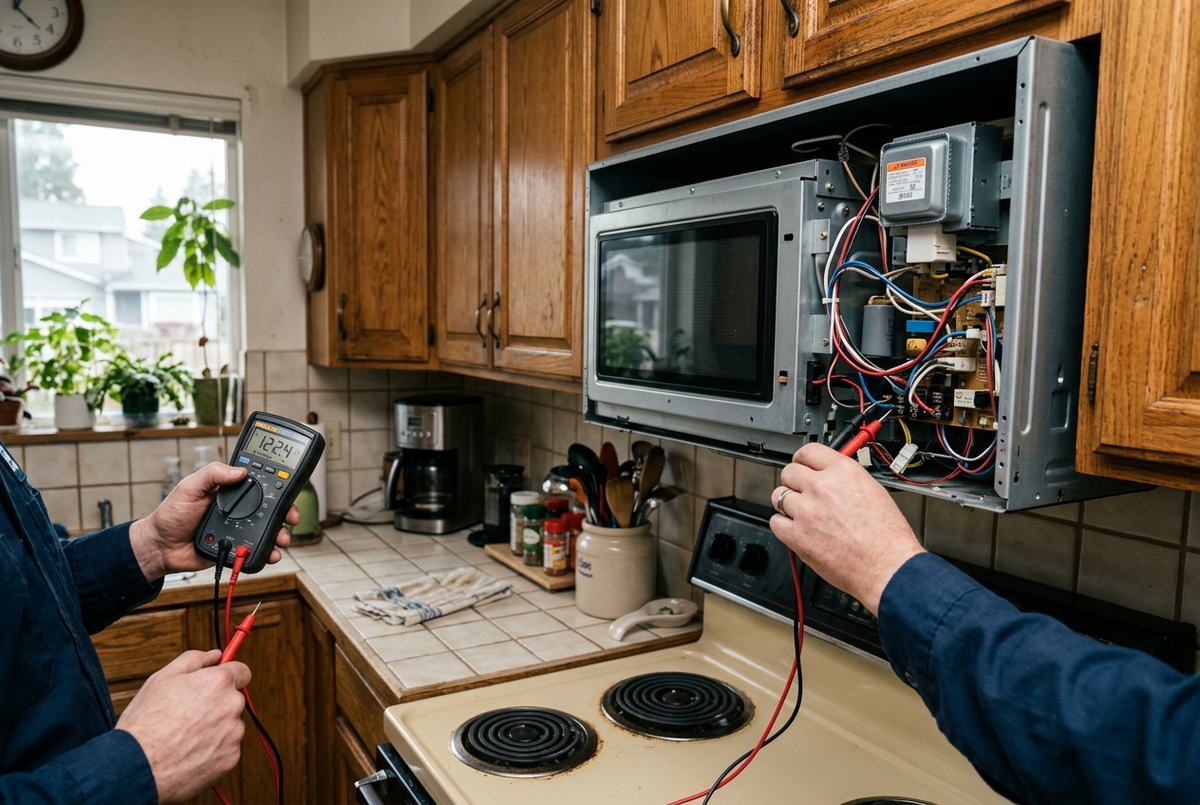
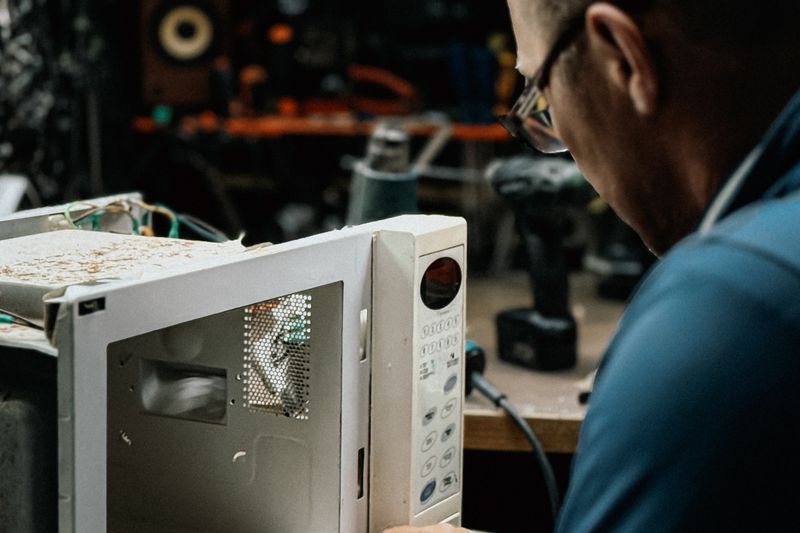
The microwave symptoms we hear most
- It runs but my food stays cold Magnetron, high-voltage diode, or capacitor failure
- Totally dead, no lights, no beep Blown line fuse, door interlock switch, or control board power
- There was a loud buzz and a burnt smell Shorted capacitor or transformer arcing
- Plate won't turn anymore Turntable motor, coupler, or drive gear
- Half the buttons don't respond Failed touchpad membrane or ribbon connection
Safe things to check first
Worth a look before you call — sometimes it saves you the visit.
- 1Plug something else into the same outlet to rule out a tripped GFCI or a dead receptacle.
- 2Push the door shut firmly and listen for the latches clicking into place.
- 3Check the touchpad for a warm, sticky film and wipe it with a barely damp cloth. Never spray it.
- 4Heat a cup of water for one minute and see whether it warms at all, because no heat points somewhere different than slow heat.
Guides & troubleshooting
Why homeowners pick a local independent shop
| CK Repair | Big-box repair chains | Handyman listings | |
|---|---|---|---|
| Written quote before any work | ✓ | ✕ | ✕ |
| Phones answered by people, every day | ✓ | ✕ | ✓ |
| Every major brand, gas or electric | ✓ | ✓ | ✕ |
| Independent shop, nobody's quota | ✓ | ✕ | ✓ |
| Crews familiar with homes like yours | ✓ | ✕ | ✓ |
Homeowners on how the visit went
“Old house, old wiring, cranky range. The tech worked around all of it without complaining once.”
Herb W.San Mateo, CA“They said morning, they meant morning. The quote said one number, the card ran that number.”
Faye D.Compton, CA“Ice maker leak had warped the floor before we noticed. They fixed the valve and pointed us to a floor guy. Above and beyond.”
Kurt V.Ventura, CAMicrowave Repair — quick answers
Is a microwave safe to open myself?
No. The capacitor can hold a lethal charge long after the unit is unplugged, and it has to be discharged with the right tool and technique. Keep the cabinet closed and let a technician deal with the high-voltage side.
My microwave sparked inside. Now what?
Unplug it and stop using it. Arcing usually traces back to a burned waveguide cover, chipped paint on the cavity wall, or metal trim on a dish. Any of those needs a look before the next use.
Can an over-the-range unit be repaired in place?
Often yes. Control boards, door switches, and fan motors are reachable once the trim is off. Heavier work sometimes means dropping the unit off the wall bracket, and we plan that with you first.
Why did the touchpad die in only one row?
Grease and steam creep behind the membrane and corrode the traces. Rows share traces, so one bad line takes out several buttons at once. That usually means a panel replacement, not a board problem.
Is it worth fixing a built-in microwave?
Built-ins and microwave drawers are worth a look, because matching the cabinet cutout and trim is difficult. We tell you which part failed and how that repair compares to replacing the whole unit.
Does hard water affect a microwave?
Not directly. But California mineral scale does show up on steam vents and sensor covers, and a crusted humidity sensor makes auto-cook cycles guess wrong. Cleaning around the sensor sometimes brings normal cooking back.
How it works
- Step 1
Tell us the symptom
Call us or fill out the form, then describe what you hear, smell or see. Odd noise, standing water, no heat. Have the model number handy if you can reach it.
- Step 2
We schedule a visit
Pick a window that fits your day. We confirm the address and ask a few questions first so the van carries parts that commonly fail on your machine.
- Step 3
Diagnose and repair
Our technician tests the machine, explains what failed and lays out your repair options. Many jobs finish the same visit. If a part has to be ordered, we schedule the return before we leave.
- A real person answers
- Open 7 days
- Written quote before work starts
Why homeowners call us
- Hard water knowledgeSacramento Valley minerals scale up heating elements, valves and spray arms. We look for buildup, not just broken parts. Clearing scale and swapping clogged components keeps a dishwasher or washer from failing the same way again.
- Heat pump dryersNewer heat pump dryers dry differently, and they fail differently. Clogged condensers, blocked drains, long cycle times, all of it has a cause. We service these units and vented models too, and we tell you what the machine needs.
- Statewide coverageWe are based in North Highlands and work across California. Coastal humidity, valley heat and desert dust each stress appliances in their own way, so we factor local conditions into the diagnosis instead of guessing.
- Straight answersSome machines are worth repairing and some are not. We tell you which, based on the failed part, the age of the unit and what else is likely to go next. Then you decide.
- All major brands, gas & electricOne independent crew for Whirlpool, Samsung, GE, LG, Maytag, Bosch and more.
- Straight answersWhen a repair doesn't make sense, we tell you, sometimes before we even roll a truck.
Microwave Repair
Small faults become big ones on a schedule of their own
Describe the symptoms and we'll book the visit — takes about a minute.
- A real person answers
- Open 7 days
- Written quotes
- All major brands
- Gas & electric
Rather not call? Get a free quote →